Showing posts with label idolatry. Show all posts

Sunday, May 23, 2010

God saves… to be full of God (Isaiah 2)

Cornerstone Mission Church, Sunday Sermon

image What’s wrong with this picture? The picture shows a boy reaching for an apple and a mother who looks like she adores her son with pure joy.

This picture is not in touch with the reality. As parents, I don’t think we ever seen our girls reaching for that healthy, delicious granny smith and have that pure joy displayed on our face with huge smiles. No, let me break it to you. Here is the reality. Parenting 101, when you take your toddlers to grocery, you avoid the aisle loaded with snacks. Those cute little hands and those little legs, those little hearts are helpless in the sight of candies, you will never get out of the aisle. So, avoid the snack aisle at all cost.image

But, then there is the inevitability of having to face the biggest challenge of doing grocery with the little toddlers. Check out line. Here is a typical picture of a checkout line. This is the most dangerous part of doing grocery. You are distracted from having to load the grocery onto the convey belt, having to wait for the clerk to scan them, having to pull out your credit card and sign it, load the grocery to your cart. And, when you are most distracted those little wondering hands can reach for that candy bar and put it in their mouth with the wrapper still on. And, just like that you lost the battle. I lost two battles so far at the grocery lines.

image Why do we battle like this as parents? Why don’t we just let them have all the candies they want to eat? Why don’t we just let them have their full? We will have happy children who would love us to death. The simplest answer is because we love them. We know once our children become full from consuming bars of chocolate, they will have no desire to eat the real food at the table, the real food that grows them.

image That is the battle we see in Isaiah 2. Jesus said in Revelation 3:20, “Here I am! I stand at the door and knock. If anyone hears my voice and opens the door, I will come in and eat with him, and he with me.” Jesus said, “I am the bread of life” in John 6:35. But, what if you are not drawn to Jesus and don’t want to open the door for Jesus to come in and dine with you because you are already full of stuff from the world?

The vision of the future: full of God.

Isaiah pictures another vision of the future. You know it is the picture of the future because it is “in the last days” (Isaiah 2:2). In his vision, Isaiah saw the mountain of the house of the LORD being established as the highest of the mountains, lifted above all the hills.

image There was a story this past week about a 13 year old boy named Jordan Romero. He took out a satellite phone and called his mother and said, “Mom, I’m calling you from the top of the world.” He is the youngest ever to climb the peak of the world’s highest mountain, the Mount Everest at 29,035 feet[1]

The temple ground of Jerusalem is elevated from the surrounding area, but it is no way the tallest mountain. Mount Everest would dwarf it. But, what Isaiah saw of the future was this picture of the nations streaming to God’s house situated on the highest mountain. Many peoples from all the nations of all different backgrounds, skin colors, cultures, languages will be streaming to the summit where God’s house dwell (Isaiah 2:2-3). We see the peoples motivating each other, calling each other out. “Come, let us go up to the mountain of the LORD” (2:3), “Come… let us walk in the light of the LORD” (2:5). Not only they yearn for God’s presence, we see them embracing God’s law, we see their intense desire to be taught in God’s ways, to walk in his paths (3:3). In this future scene where God is elevate above all things in the world, where God is the center and supreme, where God is the judge, we see this picture of incredible peace where the nations turning their weapons into the instruments of peace.

The present reality: full of stuff and full of yourself

Having presented us with the future vision full of God from 2:1-5, now the rest of the chapter 2 deals with the present reality where people are full of stuff and themselves.

In Isaiah 2:6-9, we see what the Israelites were full of. They were full of superstitions, divination and dependence on pagans. Superstitions are instead of believing in the evidence of what God is doing in our lives, believing in something like “luck” or “chance.” Divination was various practices like inquiring dead spirits, studying shapes of kidneys from dead animals in order to learn about future. In our time, practicing divination takes a much more sophisticated shape like trying to figure out the next up and coming companies, or the next hot stock items that’s going to give you greatest returns for your investment. In our time, clasping hands with pagans that is alliance with pagans is equivalent to us trying to seek happiness through other people.

They were also full of idols. He calls them “the works of their hands… what their fingers have made” in 2:8. I don’t know about you, but for me whenever I put my time and energy, and even creativity into making something, it is really hard to let go. When the ancient people either made for themselves or pay dear money for others to make idols for them, the idols required great deal of money, energy and creativity and initiation. We may not pay someone to make us piece of statue that looks like weird disproportional looking cow with big horns, but for us, our idols can take shapes of building career, reputation, keeping up with the hottest fashion, the latest and the greatest thing to have and behold, the next bigger house, the bigger wedding… the list can go. Idols can be anything that we invest our energy, our resources, and our time and takes over the center stage with the promise to make us happy and fulfill. We create idols that they may serve us.

image Consider the ugly transformation of Smeagol in the Lord of the Rings. When Semagol saw the ring that his cousin found from a lake, he claimed the ring as his birthday present. He took it by strangling his cousin to death. Over time, he became this ugly creature known as Gollum.image
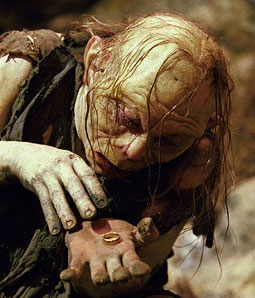
What’s behind the tight grip over idols, the practices of believing in lucks and chances, incessant obsession over controlling their own future? It’s called pride. We see the portrait of pride in more detail in Isaiah 2:10-21. The tall and lofty cedars and oaks, the towering mountains and high hills, the lofty tower and fortified walls of defensive system, the trading ships of economic prosperity were the prize possession of the ancient Israelites. Instead of seeing God’s blessings in their lives, they saw themselves as people who could engineer their own happiness with their own hands and little bit of luck. This is what pride does to a person.

The solution: throw away the idols

The solution for Gollums of today is to throw away stuffs engineered in our pride and to make the room to be full of God. That is what we see in Isaiah 2:20, “In that day men will throw away to the rodents and bats their idols of silver and idols of gold, which they made to worship.” Why would any of us throw away that which we consider precious because we made it with our own hand, precious because it has cost us money, energy, and creativity?

Isaiah gives us two reasons. Two reasons are repeated captured in these phrases, “the dread of the LORD” and “the splendor of his majesty.” He does it in verse 10, 19, and 21.

  • “The dread of the LORD” answers, “Who is in charge?” Isaiah says in verse 12, “The LORD Almighty has a day in store for all the proud and lofty, for all that is exalted (and they will be humbled),” verse 17, “the arrogance of the man will be brought low, the pride of men humbled.” When you filter through yourself and what the stuff represent through this question, you can identify if you are holding on to idols.
  • “The splendor of his majesty” answers, “Who is it for?” Another helpful way to identify idols is to ask this question. If it is sorely for our own pleasure while does nothing to bring glory to God, you know you have something that needs to go.

May God allow us to be courageous people who deal with the idols in life and the areas of pride with decisive action to rid of them!


[1] http://www.nytimes.com/2010/05/23/sports/23sportsbriefs-jordan.html

Sunday, March 4, 2007

1 Samuel 4.1-7, When you put your faith not on God...

Do you remember the movie starring Harrison Ford, Raiders of the Lost Ark? It was a huge blockbuster movie only out-earned by two prior Star Wars movies. Let me play a trailer for you.

The story takes place after 1936 featuring Harrison Ford as an archaeologist Indiana Jones. At the college where he taught he was approached by two US Army intelligence agents. He was told that the Nazis were in the quest of the Ark of the Covenant; in the movie, the Nazis supposedly believed, according to the legend, the power of the Ark to make any army in possession of it invincible.

Indian Jones found the lost Ark first, but only to be taken away by Nazis and later to be recovered by Jones. Jones was escorting the Ark to England onboard the steamer Bantu Wind only to be stopped by a Nazi U-boat. The Nazi took the Ark to a remote canyon to test its power before presenting to Hitler.

And, there is a scene where Belloq and the Nazi perform a ceremonial opening of the Ark.

This scene follows with the spirits released from the Ark and killing all the Germans by melting their faces and bodies and exploding them. And, the cover of the Ark self closing!

I am confident that none of us would watch this movie to learn the biblical facts about the Ark of the Covenant since the movie isn’t faithful to the scriptural account of the Ark of the Covenant. However, this story of Nazi trying to harvest the power of the Ark and facing devastation illustrates the story of the Israelites trying to manipulate and domesticate God for their own gain in 1 Samuel 4-7:1.

1. When you put your faith not on God, we loose the spiritual battle.

1 Samuel 4 accounts how the Ark of the Covenant was captured in the hands of the Philistines. This chapter answers this question: What happens when we put our faith not on God? The main problem was that the Israelites did not put their faith in God, but in the Ark itself. Another word, the Ark itself became an idol to them. Let see how this plays out.

We are told in verse 1-3 that the Israelites fought against Philistines, only to loose four thousand of them on the battlefield. During the time of Joshua, a similar lost was suffered at the hands of Ai in Joshua 7. When the Israelites suffered the lost, Joshua 7:6 records Joshua and the elders’ response: “Then Joshua tore his clothes and fell facedown to the ground before the Ark of the Lord, remaining there till evening. The elders of Israel did the same, and sprinkled dust on their heads.” Joshua and the elders of his time dealt with the devastating lost by turning to God in sorrow and repentant heart. God revealed to Joshua how the lost was the direct consequence of one man, Achan’s sin against God.

But the response we see in 1 Samuel 4:3 shows no such act of humbling before God, seeking his guidance for the cause of loosing the battle. Instead, they determined, “Let us bring the ark of the LORD’s covenant from Shiloh, so that it may go with us and save us from the hand of our enemies.” They believed in the power of the Ark just like the Nazis did in the movie as though the Ark in itself has the power to win the battle. The Ark represented Yahweh’s presence with Israel; it was the central symbol leading them to the Promised Land out of the desert; playing a crucial role in the crossing of the Jordan in Joshua 3-4 and during the beginning period of conquest. The Ark was important because it was the symbol of God’s presence. But, for the Israelites, the Ark itself became the power to win the battle.

They confidently marched against the Philistines now having the Ark. The Ark was tended by the wicked, good for nothing, worthless two sons of Eli, Hophni and Phinehas. The moral of the Israelites was so high that verse 5 tells how they raised a great shout that shook the ground making the Philistines tremble in fear.

So, we expect the Israelites to win, but the outcome is even more devastating than before; they lost thirty thousand foot soldiers. The two wicked sons of Eli died in the battle. Worse of all, the Philistines captured the Ark.

What happened when the Israelites put their hope, trust, their confidence not on God, but on the Ark? They were using God for their own gain, with no regard to God’s glory. They trusted not God, but the symbol of God’s presence to deliver them. God dealt with this by taking away the Ark on which they put their idolatrous faith in.

Eli having heard his sons’ death in the battlefield was so shocked when he heard the capture of the Ark, it says in verse 18, he fell backward and broke his neck. And, his daughter-in-law, the wife of Phinehas died while giving birth to her son. She named him “ichabod” meaning no glory. When the Israelites wrongly and idolatrously trusted the Ark rather than God, they suffered the devastating lost in the battlefield, loosing their own and ultimately loosing the Ark, the symbol of God’s presence.

What does God do when you and I put our faith not on God, but on the material possessions, on the job prospects, on our brains, on the get-rich and succeed-ideals of America, and on other people? We loose the spiritual battle.

2. Why should you put your faith in God alone?

Chapter 5 and 6 answers this question; “Why should we put our faith in God alone?” Why should the Israelites, the Philistines, or anyone put their trust in God alone? Let’s see how this chapter answers this question.

The Philistines feared so much that they were ready to face the major defeat against the Israelites when they learned of the presence of the Ark. But, they were able to defeat the Israelites and even capture the much feared Ark. They put the Ark next to their idol Dagon, thinking that their idol Dagon gave them the victory over the God of Israel. Depending on what sources you consult, Dagon was either a god of grain or fish. It was an idol fashioned after human image with head and arms and hands.

Next day, they found their idol fallen on its face on the ground before the Ark. They served and worshiped the idol that they had to pick up with their hands and put it back in its place. In the following morning, they found their idol Dagon decapitated and armless, with its head and hands lying on the threshold to the temple.

The writer of 1 Samuel makes an interesting observation at this point. Verse 5 says that because of their idol’s head and hands touched the threshold, they didn’t step on the threshold. Here was their idol found prostrating before the Ark in submission to God of Israel and later found destroyed before the Ark by God of Israel. God is sovereign and powerful. The wise thing would be to turn to God of Israel. But, instead of fearing God of Israel who proved more powerful and superior to the lifeless, powerless, helpless idol Dagon, they feared upsetting their destroyed idol by stepping on the threshold. It just shows the extent of their unbelief, their unwillingness to face the reality, the truth.

Perhaps, the Philistines didn’t get it that it was God who struck down and destroyed the lifeless, powerless, useless, and worthless idol. God made further statement about why he was to be feared and worshiped. Soon after, the people of Ashdod and its vicinity God sent a terrible outbreak of tumors. Some thinks it was a form of bubonic plague, tumors referring to the swelling of the infected lymph nodes, a disease carried by rats. Whatever the nature of the disease was, it was severe enough that they the people of the town of Ashdod didn’t want it any more. So, the Ark was passed down to the next town Gath. The same disaster struck the people in Gath as well. So, it was sent to Ekron. For seven months, this went on.

Chapter 6 shows how the Philistines dealt with this crisis. They recognized that the disaster was caused by possessing the Ark of the Lord. They realized that they were in the same predicament as the Egyptians faced at the hand of God. The Egyptians, especially Pharaoh hardened, their hearts against God facing plagues after plagues. They didn’t want to make the same mistake, so they devised a plan to send the Ark back. Two things matter to them

First, they made sure that the Ark was accompanied by the five gold tumors and five gold rats to honor to Israel’s God in order to appease him to stop the destruction (6:5). The Ark and the gold were to be put on a brand new cart pulled by two cows. The offering was to appease God so that the plague would stop. It wasn’t necessarily to remove their guilt because guilt offering would involve shedding of blood.

Second, they wanted to makes sure it was God who destroyed Dagan and brought the disease and death. They did this by choosing two cows that never been yoked before. The cows’ calves were pen up. The natural instinct would be for the cows to move towards their calves. Unnatural, supernatural thing would be for the cows to pull the cart holding the Ark and the gold offerings.

God proved to them it was indeed he who brought the disaster to them by having the cows pulled the cart all the way to Israel’s town, Beth Shemesh.

Once the Ark arrived, the Israelites of Beth Shemesh greatly rejoiced. The ark came to the field of Joshua. They sacrificed the cows using the wood of the cart. But, the joy was quickly replaced by fear and sadness when some of the Israelites irreverently treated the Ark by looking into it.

Why should you put your faith in God?

  • Put your faith in God because God alone is God; there is no other gods beside our God of the Bible.
  • Put your faith in God because the alternative is to face a terrible judgment; put your faith in God because he is to be feared.
  • Put your faith in God because he alone can remove the guilt of your sins and forgive you by shedding of the blood. Note how the Ark arrived at the Field of Joshua in Beth Shemesh. Joshua, the Hebrew name is the same as the Greek name Jesus. It is Jesus’ sacrificial death and shedding of his blood that truly forgives us and puts us in right relationship with God.

Applications

1. What are you idols that you trust more than God?

Think about how you might be like Israelites. When they were defeated, they didn’t seek God for his help, his guidance. They didn’t care what God really thought about their situation. Worse, they put their faith not in God, but in the object of his presence, the Ark. They made the Ark their idol.

This is like the mentality that just coming to church on Sunday is really enough. Somehow, Sunday attendance is really all that matters. Outside of Sunday, it is as though God doesn’t exist in our lives. If we act as though God doesn’t exist outside of Sunday service, then we have something other than God at the center of our lives.

2. How are you like the Philistines insisting on holding on to your idols even when God reveals himself to you in judgment and salvation?

God demonstrated his power, his superiority, his sovereignty over the idol Dagon. Yet, the Philistines didn’t abandon their idol to choose, to worship, to follow God of Israel.

God demonstrated his power by judging the Philistines by sending them the terrible plague. Yet, all they wanted was to get rid of the Ark of God so that they could go on serving their decapitated, limbless, helpless, powerless, lifeless, motionless idol that couldn’t help them, save them or do anything at all.

God demonstrated his healing, his salvation through the shedding of the blood of the sacrificed animals to Philistines. It wasn’t their gold tumors or rats that ensured the end of the plague. It was the shedding of the sacrificed animals at the field of Joshua, at the field of Jesus. It is the blood of Jesus Christ that ensures our salvation, forgiveness of sins, real life.

3. How are you like the those who were killed at Beth Shemesh by showing no fear of God by acting against his will?

Job 28:28 says, “The fear of the LORD-that is wisdom, and to shun evil is understanding.”